

2026 BARBADOS JUNIOR ROBOTICS CAMPS
CONTENTS
1.0 Camp Description
2.0 Camp Levels and Curricula
3.0 2026 Camp Application Materials
4.0 Camp Selection Criteria
5.0 Camp Fees
6.0 Application Form for Coach Positions
7.0 Benefits to Barbados and the Region
8.0 History
9.0 Robotics Camp Sponsors and Partners
1.0 Camp Description
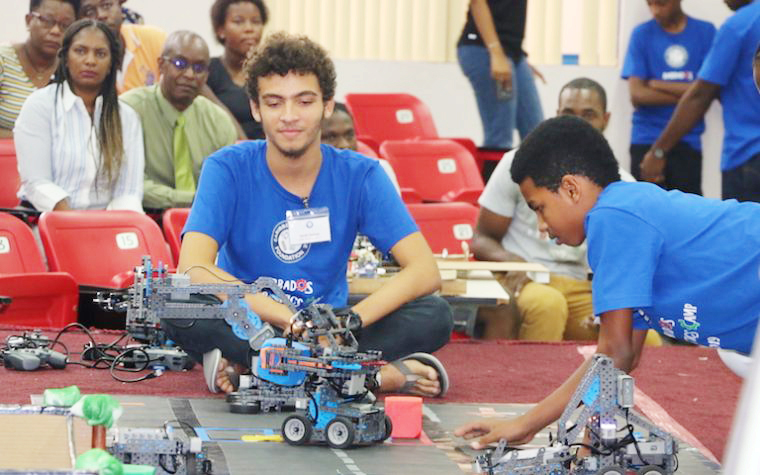
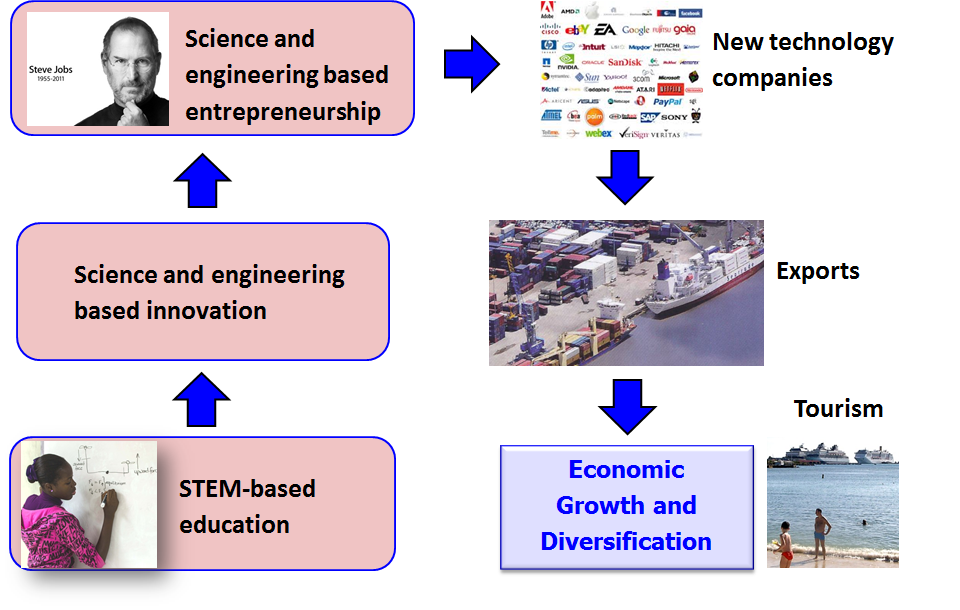
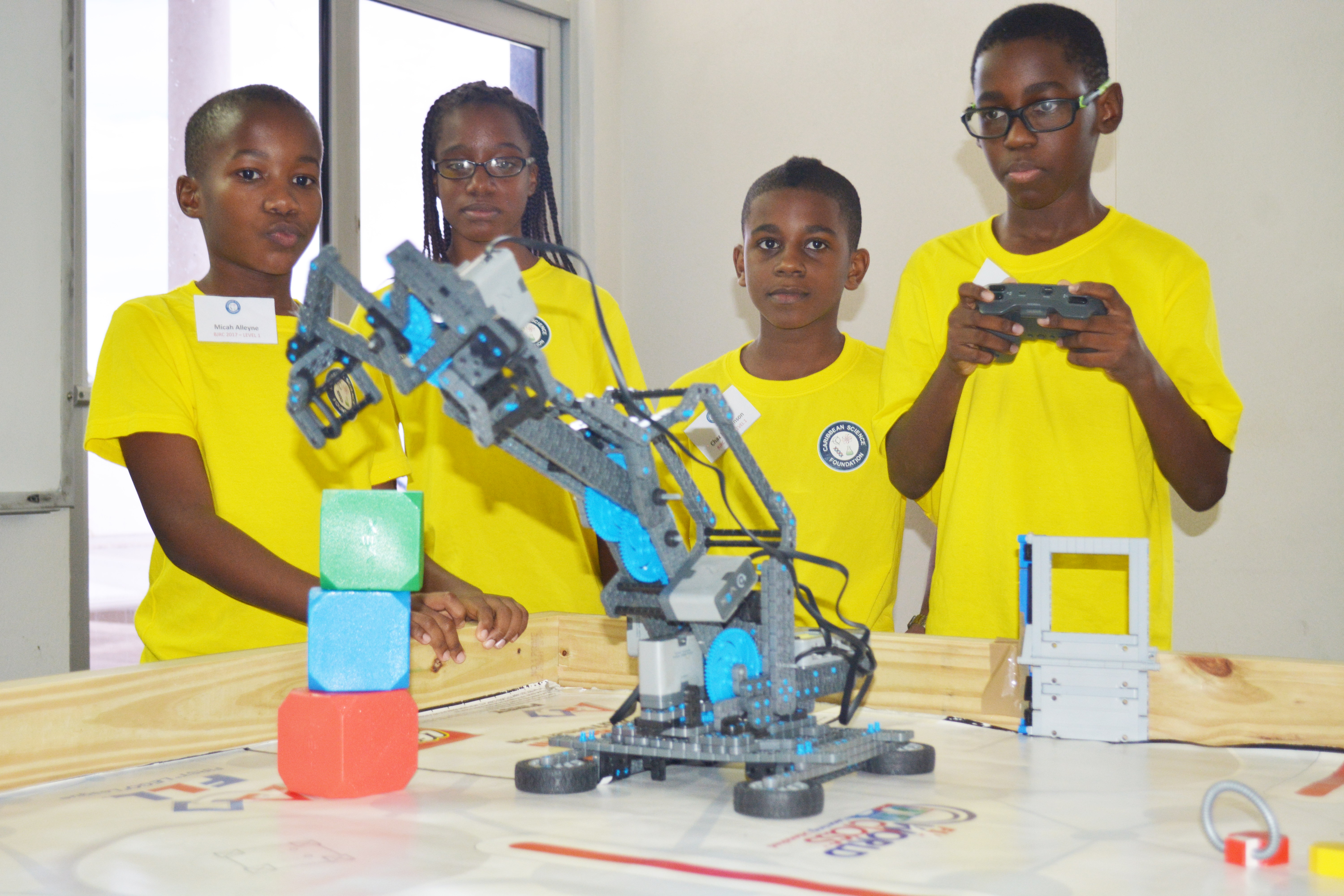
The Barbados Junior Robotics Camps (BJRC) are annual summer enrichment programs for young Barbadian students (and certain non-Barbadian students) who are interested in robotics. The BJRC are conducted by the Caribbean Science Foundation (CSF) in partnership with the UWI Cave Hill Campus. The BJRC are offered at four levels for students between 10 and 18 years of age. The CSF is committed to assisting with the enhancement of STEM education reform in the Region, and these Robotics Camps are consistent with the CSF’s primary goal of harnessing STEM for the economic development of the Region.
The specific aims of the day camps are to:
- Introduce basic technology and engineering concepts to children
- promote more interest in science and engineering to Barbadian youth.
- helping to increase the numbers of Caribbean students pursuing advanced degrees in science and engineering
- help stimulate more technology-based entrepreneurship within the Region, especially those enabled by robotics
The camp is targeted at children who are passionately interested in science and technology. The typical student who is admitted to the Camp is curious about how science works in his/her environment, is interested and eager to acquire knowledge in science, technology, engineering, and mathematics (STEM), performs consistently well at school in science and mathematics subjects, and enjoys hands-on work. Students from low-income households and girls are encouraged to apply. The aim is also a balanced class of 50% girls and boys. BJRC generally runs from mid July to mid August. Students apply directly to the CSF for admission, but a recommendation from their science, or math teacher, or previous robotics coach, or principal is required if it is their first time applying to the camp. At the camps, students participate in team-based projects in a fun environment, supervised by several coaches.
Above Video of the BJRC 2019 Showcase, courtesy of Mr. Burkley Lowe, Media Resource Department,
Barbados Ministry of Education, Technological and Vocational Training
Eligibility Requirements
The Camp is open to children who are citizens of Barbados and the other CARICOM and CARICOM Associate Countries. Children who are not citizens of Barbados may be considered for admission to the Camp if space is available in the appropriate Camp level, and they meet one of the following conditions:
- The child holds citizenship (other than Barbadian) in a CARICOM or CARICOM-Associate Country and the parents can take care of housing, meals, travel and all other living expenses for the child while the child is in Barbados for the 5 weeks of the Camp. (submit proof of citizenship with application).
- The child does not hold Caribbean Citizenship, but at least one parent has been legally stationed in Barbados for employment purposes for one or more consecutive years (submit proof with application). This category has the lowest priority for admission, and if such students are admitted, the non-CARICOM-citizen fee of BD$ 1,000 must be paid at the time of registration.
Camp Schedule
All four camp levels will run in parallel. For students, the Camp will begin on Monday 13 July 2026 and conclude on Friday 14 August 2026 with lab clean up followed by the Awards and Certificate Presentation Ceremony. The month-long camps will run Monday-Friday 9:00 am to 3:30 pm, except for holidays on the Campus of the UWI, Barbados. The highlight will be the Students’ Public Showcase of their robots in action on the afternoon of Thursday 13 August 2026.
The BJRC curricula are designed so that the students in all four camps employ basic principles from physics, learn engineering design principles, enhance their computer programming skills, and explore examples of how science and math are applied to robotics and engineering. Teamwork is an essential skill that is emphasized in all the camps, and its value is highlighted.
The program culminates with student project demonstrations in which each team first gives an oral presentation of their hands-on project before demonstrating the workings of their project. These final demonstrations are open to the public. The camps are hosted on the Cave Hill campus of the University of the West Indies (our partner). Certificates of camp completion are awarded on the last day of the camp.
The major highlight of the BJRC is the Final Projects Presentation where campers showcase their various robotics projects to the public. To ensure a successful event, campers must work diligently on their robots and presentations for the showcase throughout the five weeks of the camp. It can be a challenge to finish projects on time, as troubleshooting, fixing problems and final tweaks always take longer than expected. It is therefore essential that all campers be fully focused during the camp and be present for all camp hours. If the camper is involved in other activities that would overlap with the camp and may cause the camper to be late or miss camp days, he/she should not participate in the camp.
2.0 Camp Levels and Curricula
All four Levels expose campers to practical experiences which build confidence, social, communication, conflict resolution, and team-working skills. Practical camp experiences include: personal development sessions, brainstorming/critiquing a robotic technology solution, observation and operation of robotic technology (via video and demonstrations), and design-build-test of custom mechanisms. The students must employ basic principles from physics, learn engineering design principles, enhance their computer programming skills, and explore examples of how science and math are applied to robotics and engineering. All campers are expected to follow along with the camp content outside camp hours for the duration of the camp. This includes homework and personal study/research requiring approximately 2 hours per night (weekends included). Teamwork is an essential skill that is emphasized in all the camps, and its value is highlighted. The curricula for the 4 camps are described below.
The Levels I & II Camps – The Beginners
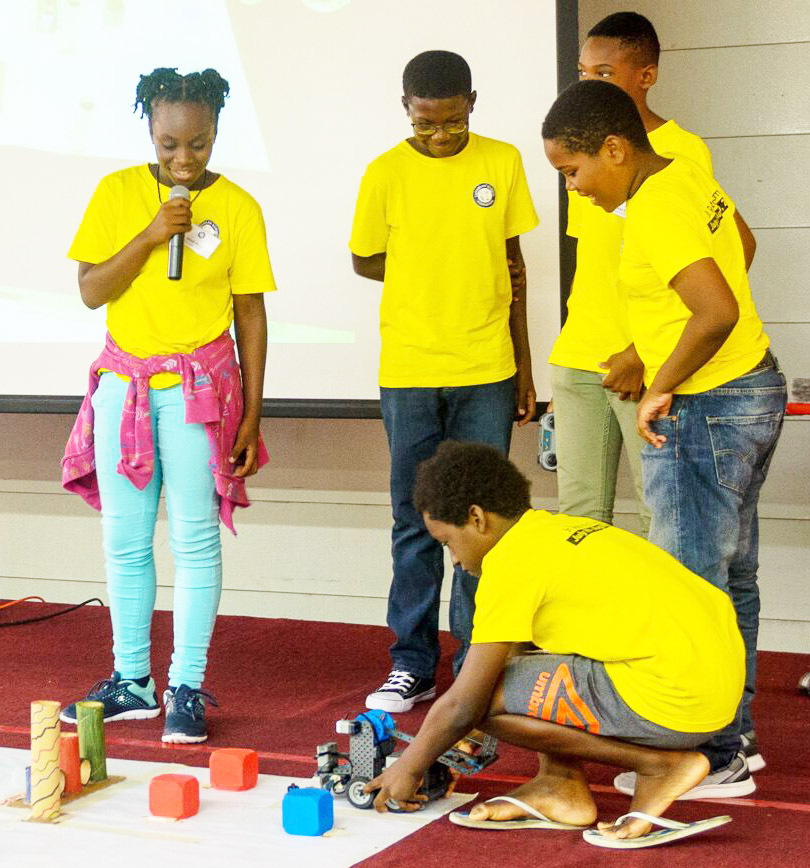
Level I students are at least 10 years of age by July 1, 2026 and have little or no previous STEM, programming, or robotics experience. We expect to have multiple Level I sections where students are assigned based on age level.
New Level II students are at least 12 years of age by July 1, 2026 and have some experience in STEM, programming, or robotics. We expect to have multiple Level II sections where students are assigned based on age level and experience in STEM, programming, and robotics. Returning Level I students or students with considerable Level I experience may be admitted to Level II based on the recommendation of the coaches. Special cases are at the discretion of the coaches.
The aim of the Levels I & II camps is to introduce STEM (Science, Technology, Engineering and Mathematics) concepts to children in the above-mentioned age range. No previous experience in robotics is required for Levels I and II campers. Students at the upper end of the Level I age range who progress rapidly may be promoted to the Level II Camp after two weeks in Level I.
The Level III Camp – The Creators
New Level III students are at least 13 years of age by July 1, 2026 and can demonstrate substantial previous STEM, programming, or robotics experience. We expect to have multiple Level III sections where students are assigned based on age level and experience in STEM, programming, and robotics. Returning Level II students or students with considerable Level II experience may be admitted to Level III based on the recommendation of the coaches. Level III applicants must: (1) demonstrate that they have the STEM, programming or robotics experience to handle the challenges that will be encountered, and (2) have a favorable review from their former coaches, and/or teachers/Principal. Special cases are at the discretion of the coaches.
The Level III syllabus comprises a mix of classroom teaching, and hands-on building, programming and the use of micro-controllers. Level III focuses on both “teleoperated” and fully “autonomous” robots that require a substantial amount of computer programming. For example some Level III robots could involve the use of AppInventor, and Arduino-kit robots. Campers will learn to document their program-algorithms using standard practices, and work with maps for navigation. The goal is to design and/or build robots that can robustly operate without human intervention (primarily through the use of “feedback-driven” action sequences created using “text-based” programming tools and complex sensors).
The Level IV Camp – The Innovators
Level IV is open to persons who are at least 15 and less than 19 years old on July 1 2026, can demonstrate substantial STEM, programming or robotics experience as well as some microcontroller experience. The lower age requirement is imposed because Level IV requires the use of power tools, and safety is our major concern (no exceptions). Level IV Campers are expected to work in a safety-conscious manner when using hand and power tools, and to document both builds and algorithms using standard practices. Level IV applicants must: (1) demonstrate that they have the STEM, programming or robotics experience to handle the challenges that will be encountered and (2) have a favorable review from their former coaches, and/or teachers. Returning Level III students or students with considerable Level III experience may be admitted to Level IV based on the recommendation of the coaches.
Level IV is not kit-based. The Level IV students are given a set of random parts, and they use 3-D printers to create custom parts as needed for their design. Level IV robots must employ micro-controllers and a high-level programming language. The goal of the Level IV Camp is to design and build fully “autonomous” robots that can address a contemporary problem, primarily through the use of “feedback-driven” action sequences created using programming tools along with simple sensors. More specifically, Level IV designs must employ Arduinos and/or Raspberry Pi’s. Preferred programming languages are Python and C++. The use of AI and machine-learning algorithms is encouraged. In 2026 Level IV students will be working on the arms and legs of mobile robot. Level IV students are expected to work in a safety-conscious manner when using hand/power tools, and to document both builds and algorithms using standard practices.

3.0 2026 Camp Application Materials
Recommendation Form for New BJRC Campers
If it’s a child’s first time applying to the BJRC, the BJRC recommendation form from either a science or math teacher, or a principal, or a robotics coach of the child is required as one component of the application to the Camp. This online recommendation form is available at the link below:
RECOMMENDATION FORM
This recommendation form should be submitted to the CSF before 11:59 pm EST on 01 July 2026. From the CSF’s perspective, the camper is ultimately responsible for making sure the teacher, coach or Principal fills out this form before the application deadline.
Survey Form for Previous BJRC Campers
Please note that all current applicants who previously participated in a CSF Robotics Camp are required to fill out and submit the online survey for the last camp in which they participated, in order for their applications to be considered. This means that previous Level I – III campers from the 2016 – 2025 BJRC who wish to participate in the next level up in the 2026 BJRC must fill out the survey for their last camp experience, if they have not already done so. The form can be accessed at the link below:
<style=”text-decoration:underline;”>ONLINE ROBOTICS CAMP FEEDBACK FORM.
Summer 2026 Student Application Form
The Summer 2026 camp student application form can be found at the link below:
2026 BJRC STUDENT APPLICATION FORM
The application deadline is 01 July 2026. Key documents you will need to complete the application form below are:
- Proof of either Barbados or Caribbean citizenship, or other citizenship
- A photograph of the camper- (head and shoulders only in .jpg or .png format) for the camper profile booklet
4.0 Camp Selection Criteria
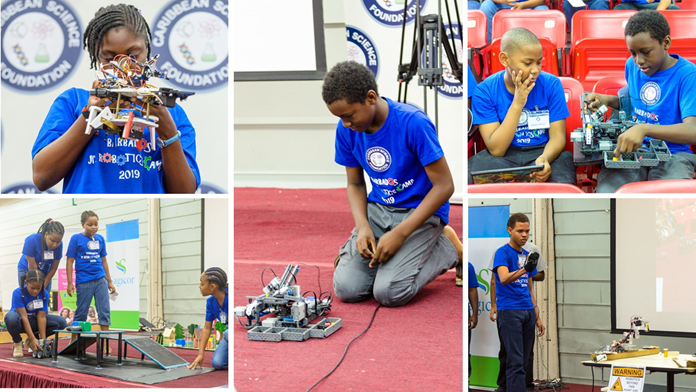
The BJRC Admissions Committee is responsible for selecting the students. The Committee comprises a subset of the Robotics Camp Planning Committee and the Head Coaches. Because of budget and/or space limitations, the Committee may have to limit the number of participants in the Camps.
The Admissions Committee will only consider complete applications that arrive before the application deadline, and the age limit for each camp and the citizenship (or the 2-year consecutive Barbados school attendance) requirement will be strictly enforced. Applicants that fail to convince the Committee that the potential camper is well behaved and interested in robotics, or in the case of Levels III and IV has the adequate background and experience to handle the work, will not be admitted to the appropriate camp. It is important to note that participation in a previous BJRC camp does not guarantee a spot in the upcoming Camp.
For all camp levels, the Admissions Committee will rank applicants taking the following factors into consideration, as appropriate:
- The strength of the recommendation from the teacher or Principal which is expected to include a statement about the behavior of the student, and about their interest in STEM, programming and/or previous robotics experience
- The behavior of the camper in any previous CSF camps or workshops, if applicable. Campers who have been disruptive or disinterested will be given the lowest priority
- An assessment of the applicant’s interest or technical background in STEM, programming and robotics based on the submitted materials, and the coaches’ evaluations if the applicant was a previous camper
- To achieve the CSF’s goal of an equal representation of boys and girls in the Camps, admissions preference will be given to the gender that is underrepresented
- The age of the applicant (older applicants will be given preference over younger applicants who have to option to re-apply in later years)
- In the event where two or more applicants are equally ranked, and the number of such applicants exceeds the unfilled spots, a lottery system will be put in place to select the remaining successful candidates
5.0 Camp Fees
The BJRC is partially funded by the camp fees of each student. The CSF, through donations from its sponsors, bears most of the financial costs associated with the BJRC. However, parents/guardians who are citizens of CARICOM and CARICOM-Associate countries are expected to contribute a camp participation fee of BD$ 500 per child for the entire month. For parents who are unable to pay the fee in full before the camp starts, the CSF can accommodate up to 4 weekly payments upon request. A minimum deposit of $20 (does not apply to non-CARICOM citizens) is required from all families (including those requesting financial aid) by the first day of camp in order to enroll each student.
The CSF does not want the inability to pay the camp fee to exclude children from the Camp. For families who are citizens of Barbados and can demonstrate extreme financial challenges (even unable to pay in weekly instalments) the CSF has set aside a limited amount of scholarship funds to assist the most needy with the camp fee. Such families can request assistance by filling out the form below:
BJRC REQUEST FOR FINANCIAL AID FORM
Filling out the form does not guarantee that financial aid will be granted. Financial assistance, if granted, may partially or fully cover the remainder of camp fee. The CSF reserves the right to fact check the claims made in the financial aid form. On the other hand, we would like to encourage families who are willing to pay more than the $500.00 camp fee to do so, as it would allow the CSF to assist more of the economically disadvantaged students.
For parents who do not hold CARICOM citizenship, but at least one parent has been legally stationed in Barbados for employment purposes for one or more consecutive years (submit proof with application) the non-CARICOM-citizen fee of BD$ 1,000 must be paid in full at the time of registration.
All campers receive a CSF robotics T-Shirt which must be worn at the Final Projects Showcase at the end of the Camp.
6.0 Application Form for Coach Positions
The CSF is seeking qualified coaches who have the experience and can commit one month in the summer to help us run the four Levels of the camp. In some cases, half-time positions are feasible.. To apply for a coach position, fill out the coach
BJRC COACH APPLICATION FORM
These positions carry a modest stipend. A signed contract with the CSF must be executed prior to employment. While BJRC coach applications are accepted at all times during the year, BJRC coach applications should ideally be submitted before 01 May of each each year as coach training begins well in advance of the camp dates.
7.0 Benefits to Barbados and the Region
The longer term benefits of the BJRC to Barbados include:
-
- STEM-focused activities like these camps will improve awareness and create and ignite passion in our young people
- The growing interest in robotics will spawn the formation of after-school robotics clubs across the Caribbean
- Eventually, robotics will make its way into the general curriculum in all schools in the Region
- The youth who participate in such camps will have a head start in joining the technology-competent workforce of the future
- A fraction of the graduates from our camps will go on to create new globally-competitive technology industries that will help to diversify the economies of the Region
- More Caribbean students will become skilled enough to compete with other youngsters in international robotics competitions
- Some of the teams formed in the BJRC will go on to compete in the Caribbean STEM Olympiads (CSO), which are held in January each year. More information about the STEM Olympiads can be found here
Barbados Junior Robotics Camp 2019
Above Barbados giving a talk and demo of drone technology and applications to the Barbados Junior Robotics camp at the University of the West Indies.
Classrom discussions, questions & answers, hands-on the equipment and an outside demonstration of modes and features.
Always amazing the level of knowledge, interest and enthusiasm from the kids!
Posted by Above Barbados on Friday, August 2, 2019
8.0 History
The Barbados Junior Robotics Camps were inspired by a group called the CSF Volunteers for Barbados. The first BJRC was held in 2015 and served 20 Level I students. The video clip below was made by Mr. Hallam Hope, a member of the Robotics Camp Planning Committee, and it shows the students at work in the inaugural 2015 camp.
<style=”text-align:right; margin: 25px;” data-width=”490″>
In 2016, a Level II was added, and in 2017 a special Level IIA was added to the existing Levels I and II. In 2018, a new Level III camp was offered as a pilot, as well as Level IIA (formerly Level II) and Level IIB (formerly Level IIA). In 2019, we again offered four levels of the Camp, renamed Levels I – IV, where Level IV was the same as the 2018 Level III. The 2019 camp served 65 students. Unfortunately, the 2020, 2021 and the 2022 camps had to be cancelled due to the coronavirus pandemic.
9.0 Robotics Camp Sponsors and Partners
 The Camps make use of the facilities of the UWI Cave Hill Campus, as part of the partnership between the CSF and UWI. Major camp expenses include:
- stipends for 16 coaches
- stipend for the trainer of the coaches
- Robotics Kits (inclusive of software)
- Arduinos, Raspberry Pi’s and specialized software
- Replacement parts for the kits
- Miscellaneous electronics, mechanical parts for Level IV
- Tools, materials and equipment for building the robots and the competition platforms.
Here is the link to a promotional fundraising video, also made by Mr. Hallam Hope. We would be most appreciative of your support.
Please contact Prof. Cardinal Warde at warde.csf@gmail.com or at 1-617-699-1281 if you (or your organization) are willing to assist.
The Institutional Camp sponsors by year are listed below:
2015
- The Barbados Ministry of Labour, Social Security and Human Resource Development
- The City of Bridgetown Credit Union
2016
- The City of Bridgetown Credit Union
- The Barbados Ministry of Labour, Social Security and Human Resource Development
- The Central Bank of Barbados
- MASA (Medical Air Services Association)
2019 Barbados Junior Robotics Camp
As a Proud Sponsor of the C.S.F Barbados Junior Robotics Camp, we wanted to give you a little insight on what really goes on at the camp and also a quick interview with one of our C.A.R.E.S Members Nyah Briggs- Blenman who is now at Level 2 at the camp.
Posted by C.O.B Co-Op Credit Union Ltd. on Wednesday, July 31, 2019
2017
- The City of Bridgetown Credit Union
- The Central Bank of Barbados
2018
- The City of Bridgetown Credit Union
- The Central Bank of Barbados
- Emera Caribbean
- Sagicor Life
- Archer Daniels Midland Co.
2019
- The City of Bridgetown Credit Union
- The Central Bank of Barbados
- Emera Caribbean
- Sagicor Life
- Archer Daniels Midland Co.
2023
- The City of Bridgetown Credit Union
- The Central Bank of Barbados
- Archer Daniels Midland Co.
- The Maria Holder Memorial Trust
- Sagicor Life
2024
- Massy Foundation
- CIBC Caribbean
- Archer Daniels Midland Co.
- The Central Bank of Barbados
- The City of Bridgetown Credit Union
2025
- Massy Foundation
- CIBC Caribbean
- The Central Bank of Barbados
- The City of Bridgetown Credit Union
- Republic Bank (PMAD Partnership)
Special Partner
The CSF remains exceedingly grateful to its partner:
- UWI‐Barbados (Cave Hill Campus)