

Caribbean SEED (STEM Engine for Economic Development) Summit
“Harnessing STEM for Caribbean Economic Development”
Contents
0. Flyer for 2026 Caribbean SEED Summit
1. Introduction
2. Why the Caribbean SEED Summit: Regional Economic Challenges
3. Several reasons to participate in the SEED Summit
4. CSF Approach to Small Business Formation
5. The SBIRD Model: Stimulating Investment in Start-ups and Early-stage Companies
6. Targeted Areas of interest
7. Events of the SEED Summit
8. How to Participate in the SEED Summit (Link to registration form included)
9. STEM Startup Challenge and Pitches by Entrepreneurs
10. Information for Entrepreneurs Desiring to Pitch a Business Plan
11. Information for Persons Contributing Papers
12. The Caribbean STEM Journal
13. Seizing a Unique Opportunity to Recruit STEM Talent
14. Expected Results
15. Supporting the SEED Summit
16. References
2026 Key Dates and Activities
- New due date for abstracts of contributed research papers and business plan summaries: 30 April 2026 (New Registration deadline)
- Extended and final registration deadline (as the agenda permits) for all research abstracts and business plan summaries: Sunday 17 May 2026
- Notification of acceptance of contributed papers and executive summaries: 07 – 21 May 2026
- Due date for fully written research papers and PowerPoint slides of business plans: 21 June 2026
- The registration form will remain open after 30 April 2026 for active observers and funding agencies, but it will close when the event capacity is reached. Full participation may be accomplished virtually (Zoom platform) or in-person. Observers who are not on the registration list will not be able to participate either virtually or in-person in the Summit
- Events of the 2026 Caribbean SEED Summit: 25-27 June 2026
NOTES:
* 25 June 2026 is dedicated to STEM Startup Challenge business plan pitches only (closed to the public)
* Opening ceremony and main events of the Summit start on Friday 26 June and continue through Saturday 27 June 2026.
* In-person venue: Accra Beach Hotel, Rockley, Barbados
Current Summit Agenda
The Summit Agenda is not fully finalized, but you can monitor is evolution HERE
1. Introduction
The theme of the annual Caribbean SEED (STEM Engine for Economic Development) Summit is “Harnessing STEM for Caribbean Economic Development”. It is an information-sharing, collaboration and brainstorming platform that brings together STEM entrepreneurs, investors, product development experts, students, educators, government officials, policymakers, researchers from academia and industry, and other leaders and experts from the Region and the Diaspora to stimulate technology company formation. Of primary interest are companies that can potentially grow to at least US$ 100 million in revenues in about 5 years.
The Summit features: (1) business plan pitches by technology entrepreneurs and early-stage companies, (2) networking sessions for the exchange of technical and business information, and (3) high-impact technology research and development presentations that are relevant to Caribbean economic development.
Persons participate both virtually and/or in person. The 2026 Summit was held in collaboration with the Barbados Ministry of Industry, Innovation, Science and Technology, and over 300 people registered
The Summit bridges the wide gap between STEM education and economic development in the Region. By creating such a recurring platform of knowledge exchange for entrepreneurial growth, the Summit will help to build a vibrant, self-sustaining STEM and business community that will help to drive Caribbean economic development for years to come. The CSF believes that “There is no reason why the next ‘Google’ cannot be created in the Caribbean”.
The Summit features all the events listed below for participation virtually and/or in-person:
- Business plan pitches by technology entrepreneurs and early-stage companies
- High-impact technology research and development presentations
- Keynote presentations by visionaries and technology leaders from the Region and the Diaspora
- Forward-looking panel discussions on how evolving breakthrough in key STEM areas could benefit the Caribbean
- Networking and brainstorming sessions
- The exchange of technical and business information
The inaugural Summit was held in collaboration with the Barbados Ministry of Industry, Innovation, Science and Technology (MIIST), but the Summit will evolve to be a joint initiative of several Caribbean entities.
For 2027 the plan is to again hold the SEED Summit in a hybrid mode with the in-person events at the Hilton Hotel, Barbados. However, all events will be available virtually for full participation on the Zoom platform. The tentative 2027 Summit dates were 19-22 May 2027. The plan is to hold the STEM Startup Challenge business plan pitches (closed to the public) on Wednesday and Thursday 19-20 May, and the opening ceremony and the remaining agenda items of the Summit on Friday and Saturday 21-22 May 2027
2. Why the Caribbean SEED Summit: Regional Economic Challenges
Global challenges such as energy security, food security, climate change, and natural threats continue to impede economic development in the Region. Also, high levels of debt and unemployment and the continued heavy reliance on traditional sectors for growth expose our economies to significant risks. For example, the Central Bank of Barbados had projected a real GDP economic growth of 2.7% for 2025 that is driven by tourism, construction and business services. Contributions from STEM-driven businesses were not explicitly identified as a significant factor in the projected growth. Further, support for STEM entrepreneurship and innovation is limited, and the skills necessary to harness the emerging technologies are lacking in the local workforce.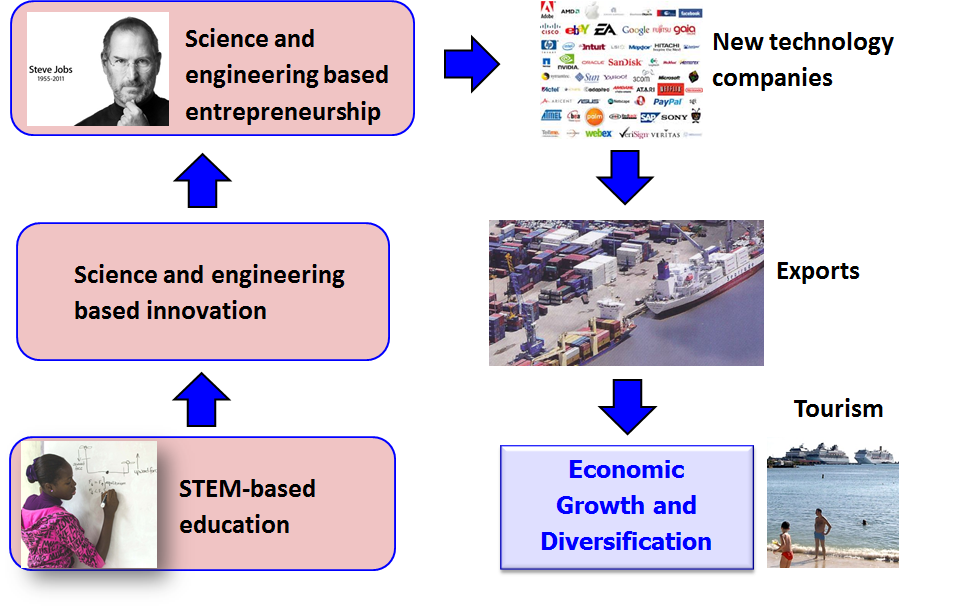
To advance our economies and mitigate the risks from global instability, new avenues for job creation, entrepreneurship and foreign investment need to be explored. One such avenue is seizing opportunities in STEM which can allow our countries to take full advantage of the potential to build a modern-day workforce and to diversify their economies through the development of STEM-based economic pillars.
This means that the Region must accelerate education reform to: (a) increase the level of interest in the sciences, (b) encourage more youth to pursue careers in science and engineering, and (c) promote more awareness in teachers and in the general population of the link between science and engineering, and economic development (Fig. 1).
The SEED Summit is a vehicle that will help address the STEM workforce challenge along with the challenges of low investment in STEM-based and STEM-enabled businesses. Its long-term desired outcomes are the significant development of globally competitive companies that: (a) produce goods and services based on new technologies, (b) apply new applications of existing technology, and (c) are technology-enhanced entrepreneurial enterprises, thereby significantly increasing the contribution to the GDP from STEM.
3. Several reasons to participate in the SEED Summit
- Want to learn how to get started on building my technology-based or technology-enabled company
- Have a great idea and want to find partners to move it towards implementation
- Want to attend the session on “Building globally-competitive technology and technology-enabled companies in the Caribbean”
- Have a crude business plan and want to pitch it to get some friendly advice so I can perfect it
- Have a refined business plan and want to pitch it to get advice and investment
- Want to network to find partners for my project or business
- Want to present a paper to showcase ground-breaking STEM research, and brainstorm on how it could be leveraged for the benefit of the Caribbean
- My government is thinking of investing in STEM startups or early-stage companies and I want to explore pathways on how to proceed
- Am looking for hot emerging technology companies in which I or my institution can invest
- Want to make social/philanthropic or charitable investment and am simply looking to see how I can best deploy my potential investment
- Want to be an advisor/mentor to technology or technology-enabled companies, and perhaps even serve as a judge on the STEM Startup Challenge
- My company is looking for STEM talent, so I just want come and fish
- Want to brainstorm company ideas in my field of interest with like-minded souls in the breakout sessions
- Generally want to help the Caribbean build globally competitive technology or technology-enabled companies, and am looking for ways to engage
- Want to get caught up on what is trending in tech
- Am a provider of corporate legal and/or accounting services and I am looking for new clients
- Want to seize this opportunity to figure out how I can give back to the Region
- Just want to be an observer
4. CSF Approach to Small Business Formation
Caribbean nationals hold prominent STEM and STEM-related positions in the Region and the Diaspora, and there is a strong Caribbean STEM talent pool in all age groups in the Region and the Diaspora. To leverage this experience and expertise for driving small business creation in the Caribbean, one approach is to follow the CSF’s technology company creation model for the Caribbean as depicted in Fig. 2.
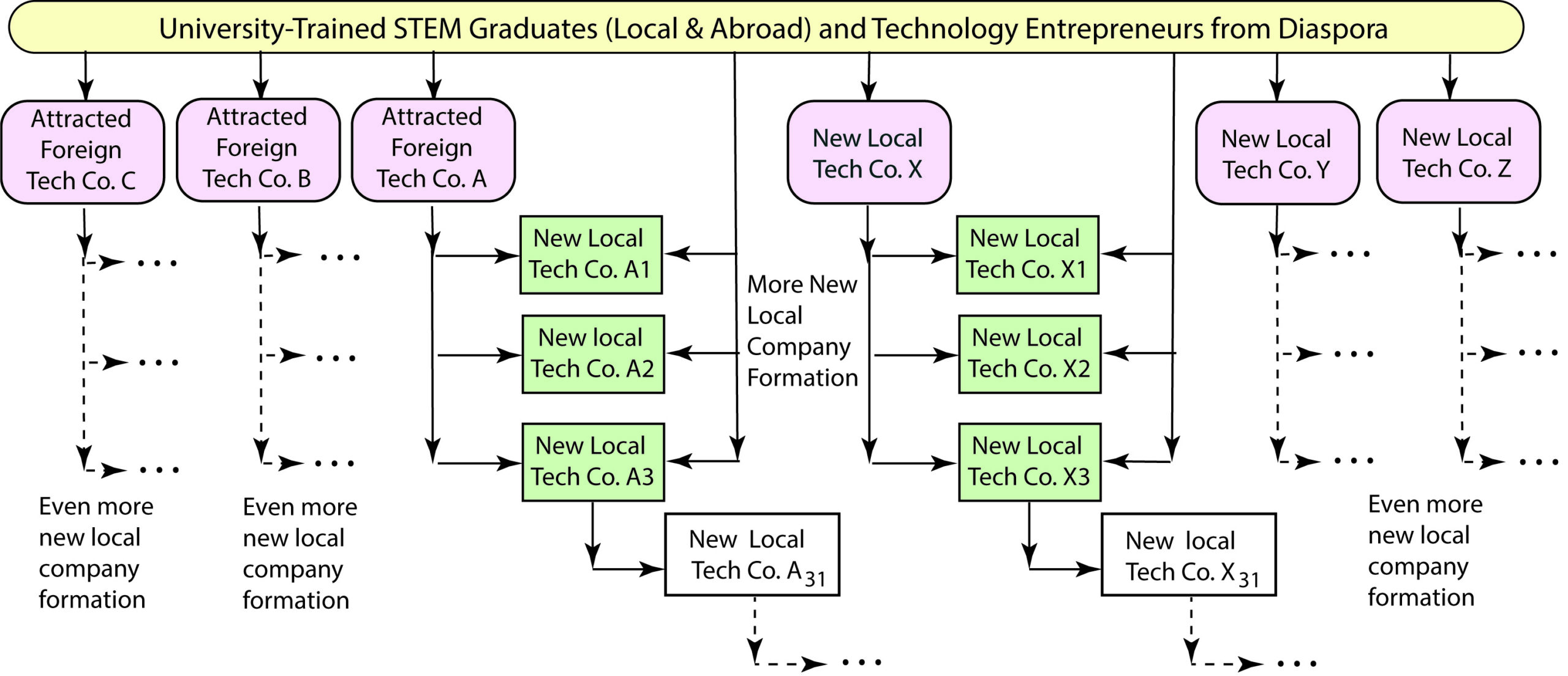
The model shows that we must attract both foreign STEM-Based companies (left half) and build home-grown companies (right half) to be successful. This would involve inviting STEM graduates abroad who want to come back to the Region, and technology entrepreneurs from the Diaspora who have an interest in working or setting up companies in the Region to join us. Incentives would have to be put in place to make it very attractive for both the foreign STEM-based companies to come to the Region, and the invited Caribbean STEM professionals and technology entrepreneurs to set up home-grown businesses or branches of their businesses in the Region.
The model shows how exponential growth of new companies will be fueled by employees of some of these early companies leaving the parent companies to set up new enterprises. The SEED Summit aims to be the catalyst that ignites this process.
5. The SBIRD Model: Stimulating Investment in Start-ups and Early-stage Companies
Caribbean government and investor involvement in the Summit is critical, as government investment into startup and early-stage companies is a major expected outcome of the SEED Summit. Therefore, in parallel with the annual Summit, the CSF urges Caribbean governments to set up programs such as the Small Business Innovative Research Development (SBIRD) program (described below and in Ref. 1 and illustrated in Fig. 3). The SBIRD program would run throughout the year and be focused on the funding of technology-based companies resulting from the SEED Summit.
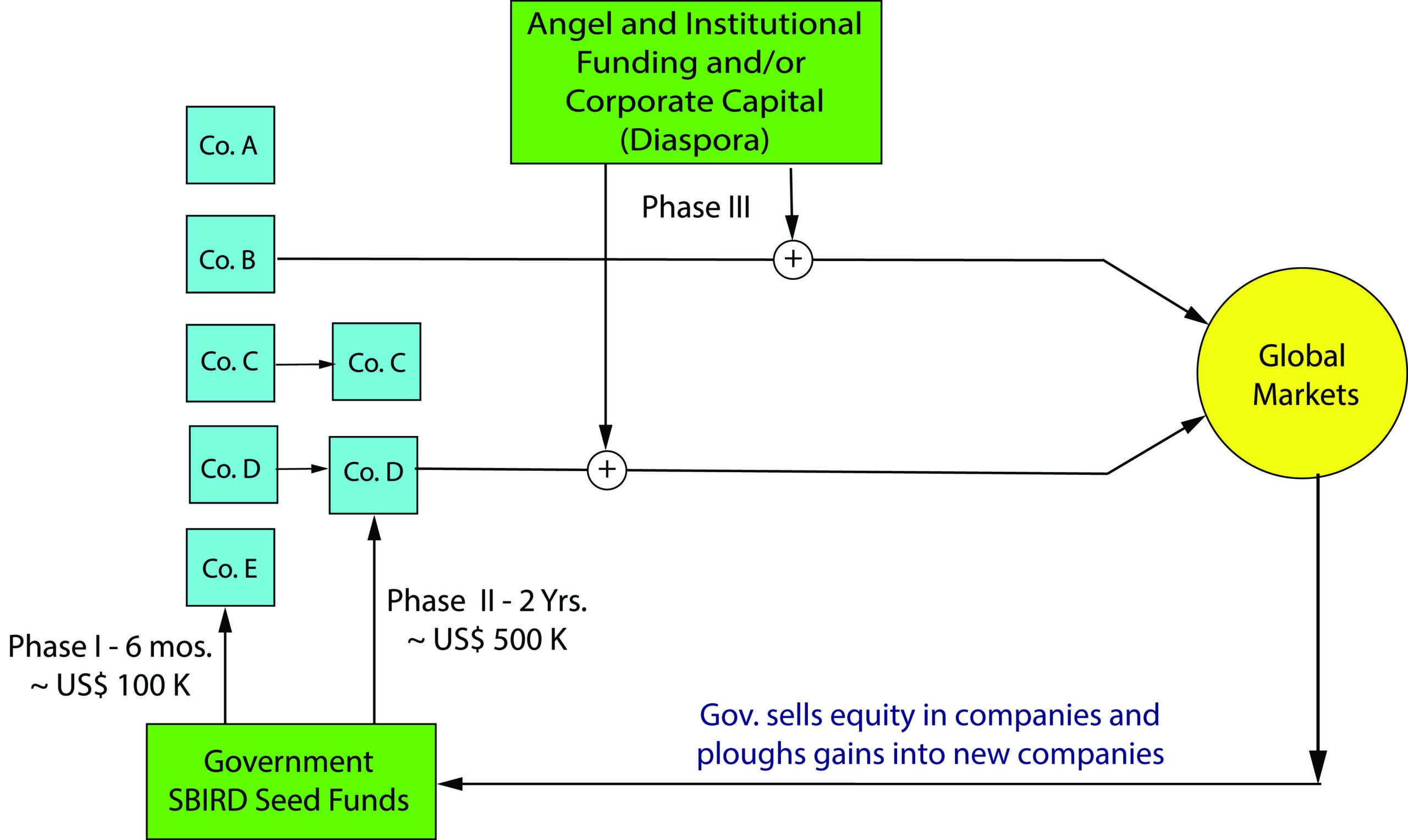
The SBIRD model is a funding vehicle that consolidates government-sponsored science and engineering research funds and provides grants to new and early-stage STEM enterprises in two phases (shown by example in Fig. 3) based on strict eligibility criteria. In Phase I, the government provides seed and early-stage (ignition) capital to small technology businesses (e.g., less than 100 employees) on a competitive basis to establish feasibility of a product or service.
Between 6 to 12 months later, Phase I awardees that successfully meet the technical feasibility milestones are invited to submit new Phase II proposals (business plans) for possible two-year funding to develop pre-manufactured prototypes of almost-market-ready products and services. The government may opt to take a small equity interest in the company for its Phase II investment. The goal of the Phase II funding is to help bring the most promising companies to a stage where they are more attractive to institutional investment. The government should follow up and assist with mentorship of the Phase II entrepreneurs and company leaders.
Phase III would be the full commercialization phase, where the funding would come from angel and institutional investors. Of course, the goal of the institutional investment is to propel as many of these companies as possible to the globally competitive stage. After the companies are successful, the government should sell its interest in the companies and re-invest the gains back into the SBIRD seed program for injection into new startups as illustrated in Fig. 3.
The CSF will assist governments with the proposal evaluation process, reviewing the performance and progress of the projects, evaluating the final reports and helping the most successful companies find Phase III funding from angel investors, and venture and corporate capital. Table 1 is a numerical example of how a Caribbean government could get its SBIRD program started via its participation in the Summit.
| Amount | ||||
| TOTAL Investments = US$ 10M | ||||
6. Targeted Areas of interest
The events of the SEED Summit will cover many of the critical STEM disciplines that align with the Caribbean’s development needs, such as:
- Agriculture and Food Science – sustainable farming, food security, and agri-tech innovation
- Renewable Resilience and Renewable Energy
- Mechanical, Electrical, Chemical, Aerospace, Biological, and Environmental Engineering
- Computer Science – Software Engineering, Artificial Intelligence, Data Science and Machine Learning, cybersecurity, digital transformation
- Fundamental Sciences – Mathematics, Biology, Chemistry, and Physics
- STEM Education Reform – innovative teaching methods and policies to strengthen regional STEM capacity
- Fintech – New approaches and regional money movement
- Business and Entrepreneurship – commercializing research, start-up ecosystems, and tech-driven economic growth
7. Events of the SEED Summit
The events of the Summit will include:
- Entrepreneurship & Investment Opportunities – A friendly pitch session (closed to the public) will allow Caribbean researchers, startups and early-stage companies to present their ideas to investors and funding agencies As part of this event, the Government of Barbados will host the Barbados STEM Startup Challenge which will be open to all STEM entrepreneurs in the Region and abroad who are interested in launching their companies in Barbados (See Sec. 8 and 9).
- Networking and brainstorming breakout-room sessions on areas such as Fintech, Agriculture and Food Science, Renewable Resilience and Renewable Energy, Engineering (all areas of interest), Computer Science, Software, Artificial Intelligence, Data Science and Machine Learning, cybersecurity, digital transformation, and STEM Education Reform.
- Keynote Presentations and Vision Talks – Leading Caribbean and international STEM and business experts will share insights on ground-breaking research, industry trends, and career pathways. Forward-thinking presentations that explore grand challenges, futuristic technologies, or strategic opportunities for the Caribbean in the global economy will be included. These talks will inspire and provoke bold ideas for action.
- Panel Discussions – Interactive sessions with invited speakers on pressing regional challenges will feature diverse voices from academia, industry, and government.
- STEM Research Presentations – Original scientific research that advance understanding and highlight future directions in a STEM field will be presented. Topics will span the targeted areas listed above. Persons interested in presenting must submit an abstract and a paper (see Sec. 7). Authors of accepted papers will be given an opportunity to present their papers during the Summit.
- STEM Talent Recruitment Opportunities for Corporations Seeking Employees – These opportunities will be offered to regional companies that support the SEED Summit. To support the Summit and ensure its long-term sustainability, corporations, NGOs and individuals may contact Prof. Cardinal Warde at warde.csf@gmail.com.
In all the events of the SEED Summit, there will be real-time Q&A and networking activities where attendees will have opportunities to engage directly with speakers, mentors, and potential collaborators. At the conclusion of the Summit, the CSF will prepare and publish the contributed papers in the Caribbean STEM Journal (see details below) and update its Database of Caribbean STEM Professionals.
8. How to Participate in the SEED Summit
There is no registration fee. Persons may participate in full either virtually online via the Zoom platform or in-person as:
- Presenters of contributed research papers (see Sec. 7)
- Entrepreneurs presenting/pitching a business plan (see Sec. 9)
- Investors and funding agencies in the STEM Startup Challenge
- Invited Keynote Speakers
- Government officials
- Active Observers (e.g., high school students, most university students, most teachers and parents)
Please note that the events of the Summit will be open to all high schools in the Region and will be streamed worldwide, making it a far-reaching educational experience.
The registration form has two Sections. All persons wishing to participate (on-line and in-person) in the SEED Summit must submit Section 1 of the Registration Form (link below). Section 1 contains biographic information only. By filling out Section 1 now, you will automatically: (a) be Zoom registered as an on-line participant for the events of the Summit, and (b) qualify for in-person access to the Summit venue in Barbados. If you are going to participate as an active observer, you need fill out Section 1 only.
Section 2 is required for persons offering to give contributed papers and talks and/or to present/pitch a business plan. Section 2 requests either a recent biographic sketch, CV or resume, and either an abstract of your paper if your are offering to present a paper, or an executive summary if you are offering to pitch your business plan (or both in some cases).
The link to the SEED Summit Registration Form can be found HERE.
The Zoom link for on-line participation in all SEED Summit events will be shared with all registered individuals at least one week before the start of the SEED Summit events.
If you are considering submitting a paper and giving an oral presentation of your paper, you can begin working on your abstract now. Similarly, if you want to pitch your business plan for the STEM Startup Challenge, you can begin working on your executive summary now. Please note that not all papers and business plans will be accepted, as they are some minimum requirements that must be met (see Secs. 7 and 9). Note that details about the submission of papers and business plans will be shared directly, after the CSF receives the completed registration/application form.
As a reminder, the key dates for the activities of the 2026 Summit are:
- New due date for abstracts of contributed research papers and business plan summaries: 30 April 2026 (New Registration deadline)
- Extended and final registration deadline (as the agenda permits) for all research abstracts and business plan summaries: Sunday 17 May 2026
- Notification of acceptance of contributed papers and executive summaries: 07 – 21 May 2026
- Due date for fully written research papers and PowerPoint slides of business plans: 21 June 2026
- The registration form will remain open after 30 April 2026 for active observers and funding agencies, but it will close when the event capacity is reached. Full participation may be accomplished virtually (Zoom platform) or in-person. Observers who are not on the registration list will not be able to participate either virtually or in-person in the Summit
- Events of the 2026 Caribbean SEED Summit: 25-27 June 2026
NOTES:
* 25 June 2026 is dedicated to STEM Startup Challenge business plan pitches only (closed to the public)
* Opening ceremony and main events of the Summit start on Friday 26 June and continue through Saturday 27 June 2026.
* In-person venue: Accra Beach Hotel, Rockley, Barbados
Please note that notification of acceptance of contributed papers and executive summaries as well as details about the submission of full papers and slides will be shared directly by 30 April 2026.
9. Caribbean STEM Startup Challenge and Pitches by Entrepreneurs
The Caribbean STEM Startup Challenge will be open to all STEM entrepreneurs with big ideas, startups and early-stage STEM or STEM-enabled companies in the Region and abroad who are interested in launching their companies or initiating their projects in the Caribbean. This is a forum where creative ideas for company formation and investment commitments or opportunities come together to propel new or early-stage companies. Of special interest are companies aiming to be globally competitive, while also capturing considerable regional market share and creating lots of new high-paying jobs. The Startup Challenge begins with entrepreneurs, startups and early stage technology companies submitting an executive summary to the Summit for consideration (see below – Information for Entrepreneurs Desiring to Pitch a Business Plan).
Using judging criteria such as technical merit, market size, niche in the competitive landscape, and potential for addressing global markets, a set of judges will give feedback and advice to all the business plans submitted. Further, the judges will forward the most promising business plans for presentation (either virtually or in-person) to a panel of investors, industry leaders and key stakeholders at the SEED Summit. The Panel will provide additional feedback and advice in all cases. In addition, the most promising and the most ready teams and companies would be recommended for funding, mentorship or incubation support under the STEM Startup Challenge program (described above), and/or be referred to funding opportunities abroad. This event will be closed to the public. It is important to note that the Government of Barbados has expressed its intent to participate with funding in the STEM Startup Challenge in 2026.
10. Information for Entrepreneurs Desiring to Pitch a Business Plan
As described above, entrepreneurs with big ideas, startups and early-stage technology companies are invited to submit an executive summary of their business plan to the STEM Startup Challenge.
Executive Summary Guidelines
Executive summaries must be submitted via the registration form. The executive summaries will be treated as confidential information and will shared only with the CSF administrative staff, the selection committee, and the relevant potential investors. Note notification of acceptance of executive summaries as well as details about the submission of slides will be shared directly by 21 May 2026.
To maintain a high standard of quality and consistency across presentations, the following formatting and submission guidelines have been developed:
-
Format:
- Length: 3 pages maximum (including embedded figures and references)
- Font Size: Minimum 10 pt
- Spacing: Single-spaced
- Name of business or project
- Description of business or project
- Category of the problem the business/project seeks to solve/its niche (see Sec. 4 –Targeted Areas of Interest)
- Relevance of business to the Caribbean, and its expected impact
- Product/service market size
- Competitive advantage
- Funding request/amount of investment being requested
- Owner(s) of the business with the person(s) making the pitch indicated by * and a footnote
Content:
Business Plan Pitch Guidelines
Entrepreneurs whose executive summaries are shortlisted are subject to the following guidelines when making their business pitch:
- Duration: 40 minutes maximum (25 minutes for presentation 15 minutes for Q&A)
- Slides: PowerPoint or Google slides, and must be presentation-ready (clean, clear, and visually accessible)
- Language: Presentations must be delivered in English
- A copy of your slide deck must be submitted to the CSF no later than 21 June 2026. The slide deck will be treated as confidential information and will shared only with the CSF administrative staff and the relevant potential investors.
Business Plan Judging Criteria
Below are some of the business plan components that you must cover persuasively, as the judges will be looking for them to be addressed in your presentation. These components were taken from the judges scoresheet and each item is worth 5 points. What stood out in the 2026 presentations was that almost all the plans presented were weak on the financial segments of the plan.
- Does your plan address a significant unmet need or a demand for a solution in the Caribbean or globally?
- How well does your approach/product solve the problem?
- What advantages does your potential product or service have over its competitors, and how significant are these advantages?
- Is your idea original or a new concept? Does your company have IP on the technology and/or a go-forward IP strategy (if applicable)?
- Is your target market identified and well understood, and is your potential market penetration/share justified?
- Does your team have a solid work plan (activities, timeline and milestones) to develop the product or service aimed at its target customers? Does the company have partners? What do your partners give/get?
- Does your company have a strong revenue generation plan? How well are your costs and pricing structure explained? How will the product or service be marketed? Is the business scalable?
- Is your team uniquely qualified to build and scale this solution? Can your team attract and retain the right talent? Does your team have credible advisors who can really assist the team?
- Are the resources (facilities, equipment, materials and supplies, etc.) you need adequately identified? Is your plan for acquiring the resources realistic?
- Is the budget to support the above work plan realistic? Is your use of funds adequately explained? Is your breakeven point realistic?
- Is your financing strategy clear and compelling? Is it clear how your investors will benefit?
- How was your overall pitch deck? How effective was your presentation in conveying the solution to the challenge?
11. Information for Persons Contributing Papers
Call for Contributed Papers
During the SEED Summit, a roster of about 15- 20 persons contributing papers (not including the entrepreneurs pitching their business plans) will be presenting in multiple sessions ensuring diverse perspectives and comprehensive coverage of topics. The Summit welcomes contributed papers from persons who are working on STEM-related research projects or initiatives that directly impact or involve the Caribbean region, in the targeted areas of interest (see Sec. 4). Contributed papers are defined as those that follow the guidelines below and are submitted with the aim of being presented during the Summit. Contributed papers may be delivered either in-person or virtually.
Presenters of contributed papers represent a wide range of individuals committed to STEM advancement in the Caribbean. These may include:
- Outstanding Diaspora and regional STEM professionals, researchers and academicians with ongoing or potential collaborations in STEM fields in the Caribbean
- Outstanding University students pursuing STEM pathways, and in particular certain graduates from the CSF’s SPISE Program
- Ministries of Education, Ministries of Science & Technology, and regional policy makers
- STEM educators and education reform advocates
 All presenters must be able to demonstrate a strong ethnic, professional, business or academic association with the Caribbean region. Submissions of papers for presentation must be directly relevant to the Caribbean—whether through the focus of the research, its intended impact, or its implementation within the Region. That is, the authors must explicitly explain how their work is linked to the Caribbean development objectives. This ensures that the SEED Summit remains rooted in regional advancement while highlighting the contributions of Caribbean nationals and allies committed to STEM development across the Region.
Abstract, Oral Presentation and Paper Submission Guidelines
For persons wishing to give a talk at the Summit, here are the steps involved:
- The first step is for the prospective author(s) to submit an abstract via the registration form on the Summit Website.
- Next, the abstract will be reviewed by a panel of experts and notification of acceptance of the abstract will be shared with the authors by 30 April 2026
- If the abstract is accepted, the primary author will be contacted with information on when their talk is slated for presentation. The authors may choose to give their presentation virtually or in-person, with or without slides. However, the CSF recommends the use of slides
- The authors also have the option to submit a full paper of their presentation for publication in the Caribbean STEM Journal whether or not it was accepted for oral presentation
Abstract Preparation Guidelines:
To maintain a high standard of quality and consistency across presentations, the abstract submission should include the following information:
- Title of the submission
- Category of the research paper (see Sec 4. – Targeted Areas of Interest)
- List of authors with affiliations (work, company, or other affiliation as appropriate). The presenting author should be indicated by * and a footnote
- Body of the abstract as a 150–300-word summary outlining the core idea, relevance to the Caribbean, and expected impact
The abstracts will be published in the Speakers’ Booklet which will be distributed to all Summit delegates.
Oral Presentation:
Authors whose papers are accepted for presentation, and all other invited speakers must make oral presentations of their work, subject to the following guidelines:
- Duration: 15 minutes maximum, inclusive of Q&A
- Language: Presentations must be delivered in English
- Slides:, If slides are used, they must be clean, clear, visually appealing, and presentation ready, and must be submitted at least 2 days in advance of the talk. This is because all the slides will be run from a single computer at the Summit to minimize down time
- Format: PowerPoint or PDF (Standard 4:3 aspect ratio)
Publication of Research Papers:
A full paper of your presentation is necessary only if you wish to submit it for publication in the Caribbean STEM Journal (CSJ). Even though CSJ papers are not peer reviewed at this time, submission of a paper does not guarantee acceptance for publication. The CSJ has certain minimum standards for manuscript content quality and relevance to the challenges of the Region that are set by the editorial committee. Also, please note that at this time the CSJ will consider papers that include summaries of previously published work if said work can be demonstrated to have strong relevance to the challenges of the Caribbean or to Caribbean economic development (see Evaluation Criteria below). Importantly, please be advised that the due date for 2026 manuscripts has been extended to 31 January 2027.
To reduce our publication costs, we prefer to receive almost camera-ready copies of submitted papers. We need all papers to have the same look, feel and style in the Journal. Thus, it is important that all papers being submitted follow the guidelines provided below:
Manuscript Submission Guidelines:
- Please submit your paper as a LaTex file (.tex), if possible. We recommend that all authors use the IEEE template in Overleaf. If you are not familiar with Overleaf or do not usually use this software, you may download a free copy of Overleaf from the Web, and then choose the IEEE template which uses 2 columns per page.
- When submitting your manuscript, please send us the .tex file, the .bib file and separate files for each of your figures and photos along with the pdf file of the complete paper (all of which are automatically generated by Overleaf). Keep in mind that we will need to make minor formatting changes to your files so that all papers in the Journal have the same style, font-type, and references cited in a similar style for uniform visual appeal
- If you are unable to submit your manuscript as a LaTex file, please send us editable files of your text, diagrams, photos and tables, as our team will have to convert your manuscript to a LaTex file (.tex) for seamless incorporation into the Journal. Accepted text files include *.tex, *.docx, *.doc, and *.rtf. Acceptable editable files of photos, diagrams that we can readily insert into the new LaTex document include *.jpg, *.png, *.psd, *.eps, *.ai, and *.pdf. We will still need a pdf of your full manuscript, as we will use it to make sure our generated LaTex file matches your pdf version. Clearly, this submission option may slow down publication of the Journal, so we would very much prefer to receive the full suite of LaTex manuscript files as listed above, if possible
- Submissions should be written in clear, professional English and provide sufficient context for interdisciplinary understanding
- The length of your manuscript should be between 3 and 12 pages (including embedded figures and references)
- The minimum font size is 10 pt, and papers should be submitted single-spaced with two columns per page
- Please submit your files to applications.csf@gmail.com with the following words somewhere in the subject line “{your name} _2026_Caribbean_STEM_Journal_ Submission {submission date}” so we can easily identify it. If for any reason you need to send us a revised version, please make sure to change the submission date in the filename to avoid version-control confusion problems
- Timely, high-quality papers from authors who did not send an abstract to the 2026 SEED summit will be considered, if such papers are of very high significance to the challenges or the economic development of the Region. However, final decisions will be made on a case-by-case basis by the editorial committee
However, a *.tex file of the manuscript written with any editor will be tremendously helpful.
The new submission deadline for 2026 manuscripts is January 31st, 2027. The plan is to publish the 2026 Journal by April of 2027 (before the next CSS which is scheduled for 19-22 May 2027). The submission deadline for 2027 manuscripts will be August 31st, 2027.
Evaluation Criteria for Papers:
All submissions will be evaluated by the editorial review committee based on four key criteria to ensure alignment with the Summit’s goals:
- Strong relevance to the challenges of the Region or to Caribbean economic development, whether through the work’s focus, application, or potential impact
- Technical feasibility must be demonstrated through literature support or original data. Papers mostly proposing to do future research and have little or no substantiated results will generally not be accepted for publication
- Commercial potential with significant promise for scalability and real-world application, in the Caribbean and/or globally
- Previously published work may be considered for acceptance if it is modified to emphasize and cover solutions to challenges facing the Caribbean
12. The Caribbean STEM Journal
The Caribbean STEM Journal (CSJ) will be the official Journal of the SEED Summit. The goal of the CSJ is to inform a Caribbean audience about cutting-edge research being done around the world that may be of direct benefit to the Region. It will be produced in digital form after the conclusion of the Summit and will provide a record of the event with insights, outcomes and future pathways identified. The content will cover topics such as:
- The CSF Directors’ message and SEED Summit vision and goals
- Thematic areas of focus
- Full papers on cutting edge research that is of relevance to the challenges of the Caribbean or Caribbean economic development.
- Caribbean STEM Startup Challenge summary
Please note that CSJ papers are not peer reviewed at this time, and the Journal will accept papers that include summaries of previously published work if said work can be demonstrated to have strong relevance to the challenges of the Caribbean. Also please note that submission of a paper does not guarantee acceptance for publication, as the Journal has certain minimum standards for content quality and for relevance to the challenges of the Region or to Caribbean economic development that are set by the editorial committee.
13. Seizing a Unique Opportunity to Recruit STEM Talent
Based on the work of the CSF in the Diaspora (see Caribbean Diaspora for Science Technology and Innovation) we have observed that there are many Caribbean STEM professionals and terminal-degree students (at the Masters and Ph.D. level) in the Diaspora and the Region who are conducting cutting-edge research across multiple key areas of science and engineering. Many of them are helping to increase the GDP of the countries in which they reside, and a substantial fraction of them would like to contribute to the Caribbean. Most importantly, many of them are interested in technology entrepreneurship and would join or create startups in the Region if the opportunities to do so were present.
 One subset of this larger group is the students who graduated from the CSF’s SPISE (Student Program for Innovation in Science and Engineering- see https://caribbeanscience.org/SPISE). Over the past 14 years, several Caribbean organizations and high-net-worth individuals have invested collectively about US$ 1.8M in advancing the STEM aspirations of 265 SPISE scholars. In their application forms to SPISE, these students had all pledged to give back to the Caribbean at some appropriate time in their lives.
Thirty-two of these students have attended or are attending MIT (the premier science and engineering university in the world) and many others have graduated from universities such as Stanford, Princeton, Columbia, Harvard, Dartmouth, U Penn, Georgia Tech, University of Rochester, University of Toronto, McGill, McMaster Univ., Univ. College London, Imperial College, and UWI. Further, several SPISE graduates have or are now pursuing advanced degrees in STEM at the M.S. and Ph.D. levels at MIT, Stanford, Harvard, Johns Hopkins University, Yale, Princeton, Dartmouth, Carnegie Mellon, University of Washington and University of Pittsburgh. We believe that the SEED Summit could represent a first step towards not only mobilizing the scientific Diaspora for the benefit of the Region, but also providing an opportunity to capitalize on the above investments made in our youth.
With the SEED Summit placing a strong emphasis on youth engagement, entrepreneurship, and interdisciplinary problem-solving, and with the Region facing a STEM deficit, the summit will be an important step in the process of STEM education reform.
Whether you are a student exploring STEM careers, a researcher seeking collaborators, an entrepreneur with a bold idea, an investor looking for technology-based companies in the Caribbean to support, or a policymaker invested in sustainable development, this summit is your opportunity to connect, learn, and contribute to the STEM revolution of the Caribbean.
14. Longer-term Expected Results
The SEED Summit provides substantial value not just to individuals, but to the entire Caribbean. As such, it will:
- Inform policy makers by providing and stimulating discourse on how STEM can be employed to enhance regional economic development.
- Stimulate more investments by Governments of the Region into technology companies that appear to have the highest probability for commercial success, using the SBIRD model or similar.
- Result in more funding agencies meeting with teams that will build new companies or enhance the growth and performance of existing companies.
- Attract more foreign investment into Caribbean-led STEM ventures via the STEM Startup Challenge which will provide a tremendous opportunity for boosting job creation and economic diversification.
- Produce economic diversification and growth by nurturing a culture of innovation and supporting tech-based startups, thereby contributing to the diversification of Caribbean economies.
- Assist with future workforce development by encouraging skill-building in areas that are critical for future employment and competitiveness in a global economy.
- Create new job connections by giving our underemployed or unemployed STEM university students the opportunity to build new relationships with established STEM professionals and experts and funding agencies.
- Inspire and empower our youth by informing and motivating the Region’s next generation of scientists and engineers through highlighting the achievements of Caribbean STEM professionals and exposure to real-world applications.
- Enhance STEM education reform by promoting modern, project-based STEM education that aligns with the 21st-century and the needs of the Region.
- Provide access for local and regional companies to more highly-qualified STEM talent by facilitating connections that will result in recruiting consultants and hiring new STEM employees.
- Strengthen regional innovation ecosystems by fostering research collaborations and startup incubation.
- Ignite more regional and Diaspora integration by uniting actions from across the Caribbean and the Diaspora, fostering a collaborative approach to our shared challenges.
- Launch and sustain the Caribbean STEM Journal, a regional repository of STEM talent and ideas, that outlasts the Summit and can be used for the benefit of the Region for many years.
15. Supporting the SEED Summit
Local, regional and international corporations, NGOs, governments and individuals who may want to support the Summit to ensure its long-term sustainability, can contact Prof. Cardinal Warde at warde.csf@gmail.com. In return, the CSF will assist with access to local and regional highly qualified STEM talent and consultants, if that is of interest.
16. References
Flyer for the 2026 Caribbean SEED Summit
